
Exceptional pediatric care uncovers rare disease of esophagus
February 26, 2026Categories: Pediatrics Care
Learn more about MercyOne Gastroenterology Care
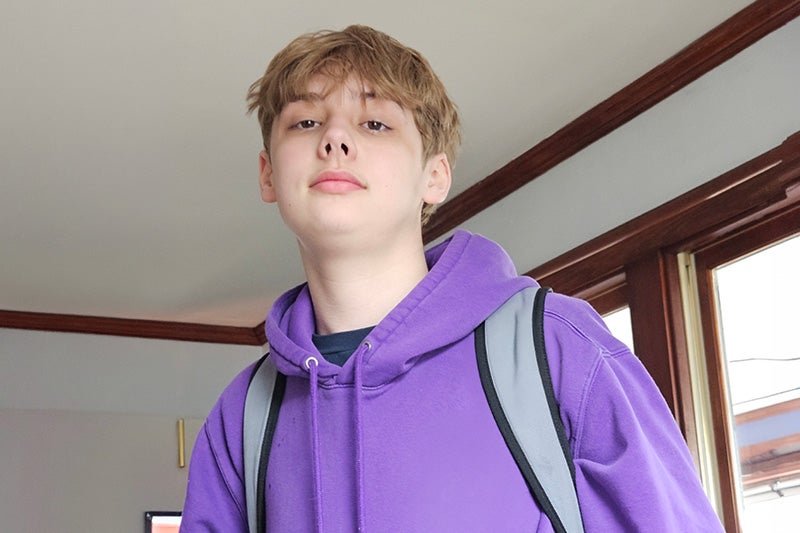
Trevor Neuman had meals in his room to avoid eating in front of people. When he swallowed food, he’d often choke and pound on his chest to get it unstuck on the way down. A single bite could take two to three minutes to swallow.
At one point in panic, Trevor, 17, told his mom, “I need to go to the hospital. I’m going to die.”
His problem? A rare condition of the esophagus, the hollow, muscular tube that passes food and liquid from the throat to stomach. After months of growing discomfort, MercyOne Des Moines Pediatric Gastroenterology Care would use first-in-Des Moines pediatric technology to diagnose Trevor and get him the treatment he needed.
Starving to eat
But first, Trevor would cope with the isolation of eating alone, undergo multiple, “miserable” tests down his esophagus and rapidly lose more than 30 pounds and face the possibility of a feeding tube. He never ate lunch at school; he wasn’t eating his parents “out of house and home” like most 17-year-olds. When he said he was “starving,” he literally was.
It was a caring MercyOne pediatric gastroenterologist, Hazim Zaghloul, MD, who would go above and beyond to test and diagnose Trevor and help his family navigate the tests needed for health insurance coverage for his rare condition.
Today, Trevor and his mother, Dorie Neuman, of West Des Moines, Iowa, look back on a difficult year that culminated in a rare surgery in October 2025.
Hungry for answers
At first, Dorie thought her son wanted to eat in his room, so he could play video games like many teenagers. “When he told me he couldn’t swallow food, I thought at first he was being dramatic,” she recalled.
However, it soon became clear that Trevor ate in his room, usually while standing, so he could get his food down in private -- often chasing it down with liquids, pounding his burning chest or regurgitating the food he’d just tried to swallow.
“We went out to eat for his birthday once, and it was horrible,” Dorie recalled. “Trevor was in the bathroom probably nine times during the meal. He was doing a lot of vomiting when he ate.”
Trevor’s plight to eat soon became a desperate search for answers and a diagnosis, as his condition worsened, Dorie said. Dr. Zaghloul would provide the testing and diagnoses Trevor needed.
After stretching the esophagus didn’t help, Trevor underwent an endoscopy with a Medtronic EndoFLIP™ test. MercyOne Children’s Hospital is the only pediatric hospital in Iowa that uses EndoFLIP technology. This test involves placing a small fluid-filled balloon in the esophagus through a catheter to measure in real-time how the muscles contract and relax. The tests showed furrowing in Trevor’s esophagus. He was given a potent corticosteroid to treat his esophagus inflammation.
Two months later Trevor returned to the clinic, having lost a lot of weight. A repeat upper endoscopy and EndoFLIP™ test showed Trevor’s esophagus had narrowed much more. Esophageal manometry was also used to measure and record changes in pressure throughout the throat and esophagus as Trevor swallowed.
Finally, a rare diagnosis
Trevor was diagnosed with Achalasia Type 2, a rare disorder in which the muscles in the esophagus don’t contract properly to move swallowed food into the stomach. The ring of muscle at the bottom end of the esophagus is too tight and unable to relax to let the food into the stomach. Trevor was prescribed Nifedipine, which gave him significant relief of his swallowing challenges, and he gained a few pounds within a week.
“Dr. Zaghloul called me at home, after hours, he was amazing to help Trevor get through the right tests for the insurance company to say, ‘OK.’” Dorie said. “He kept trying to fight for us and find the answers. From one test to the next, Trevor got bad very quickly and lost 12% of his body weight. When your kid’s in dire straits, you don’t have time to wait for an insurance company to make their decision.”
Trevor was referred to the Mayo Clinic, where he had surgery for his 1 in 100,000 condition. In a Heller myotomy procedure, Trevor’s lower esophageal sphincter muscle was cut. Part of his stomach was wrapped around the lower esophagus to create a valve to keep reflux from flowing from the stomach into his esophagus.
“The doctor explained that the surgery opened a gate to help get the food down and said Dr. Zaghloul did an amazing job getting him all the tests that needed to be done.”
While the surgery isn’t a cure, it has helped Trevor’s symptoms. He’s eating in public again and at a healthy weight. For the rest of his life, he’ll need to avoid raw vegetables, carbonated drinks and eat slowly and take small bites. Trevor has faced disappointment that his condition will prevent him from having a career in the military.
Both Trevor and Dorie will never forget their committed MercyOne pediatric gastroenterologist. “Dr. Zaghloul went above and beyond as a doctor,” Dorie concluded. “That’s what we need as families when we’re going through difficult times like this.”
Learn more about pediatric specialty services at MercyOne.