A heart-stopping rescue: MercyOne Des Moines team defies survival odds of cardiac arrest
April 17, 2026Categories: Heart Patient Stories
Learn more about MercyOne Heart and Vascular Care
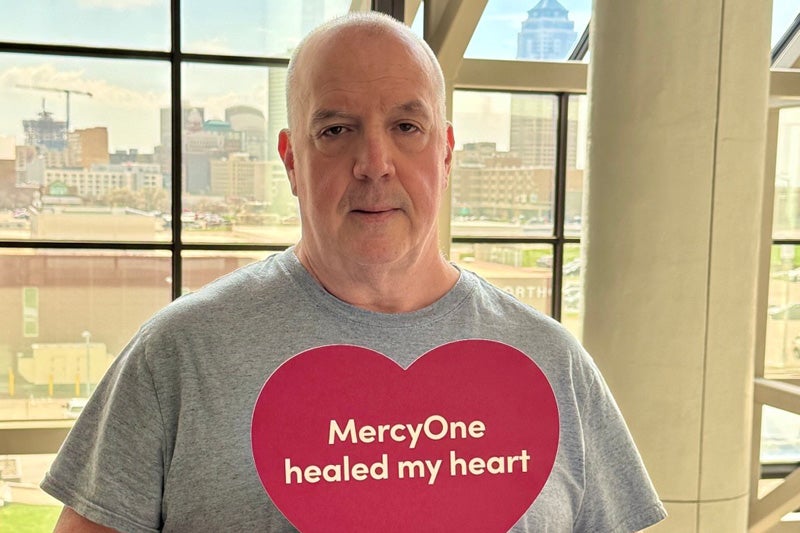
Minutes matter. No one knows this better than Charlie Triplett, whose heart stopped, as “luck” would have it, right after he arrived by ambulance to MercyOne Des Moines Medical Center.
What transpired next is a testament to the life-saving efforts of multiple MercyOne specialists and the hospital’s advanced artificial life support technology that did the work for Charlie’s heart when it couldn’t.
Had he arrived just a few minutes later, Charlie may not have survived his cardiac arrest. About 90% of people who have an out-of-hospital cardiac arrest die before they reach a medical center.
"You were dead"
Several months later. he's still piecing together that day, Jan. 14, 2026. Charlie, getting ready to take a nap in his bedroom, had some chest pain that he first attributed to indigestion or an esophageal spasm. He was being evaluated for occasional chest pain.
One, then two, nitroglycerin pills later the pain continued to escalate. Something was definitely wrong but did it warrant calling for an ambulance?
“Thank God, I put my ego aside, went downstairs and told my wife, Julie, ‘We need to call 911,’” recalled Charlie of West Des Moines, Iowa. “As soon as I said those words, the crushing chest pain began.”
He remembers his wife calling 911 and reaching excruciating pain on the ambulance ride to the hospital. "People talk about it feeling like an elephant stepping on your chest, and I can tell you that’s what it felt like.”
Then, what will forever fill him with gratitude, the opportune timing of Charlie’s heart stopping shortly after arriving at the Emergency Department (ED). “I had a 100% blocked artery that caused me to go into ventricular fibrillation. My heart stopped. I had no pulse.”
A well-coordinated team
What Charlie doesn’t remember is receiving CPR; having his heart electrically shocked at least nine times; being put on a ventilator; and then hooked up to an external heart-lung bypass machine called VA- ECMO, or Veno-arterial Extracorporeal Membrane Oxygenation.
This temporary, advanced life support system, placed by Shrey Velani, MD, constantly pumps blood out of the body and then sends it through devices that add oxygen and remove carbon dioxide, before pumping the blood back into the body to bypass the heart and lungs.
While not a cure, VA-ECMO acts as a “bridge” to allow time for the heart and lungs to heal from life-threatening conditions, such as cardiac arrest.
Once stabilized, Charlie had an emergency catheterization, where a 100% blockage was found in the left circumflex artery. Interventional cardiologist Atul Chawla, MD, deployed a stent to open the blockage. He put a second stent in another artery that was 95% blocked. Charlie stayed on the VA-ECMO machine for about 48 hours, recuperating in the Cardiac Intensive Care Unit.
After that, vascular surgeon Harold Hsu, MD, repaired his leg, removing the large cannula placed in Charlies femoral artery where the ECMO machine had been hooked up. His intubation tube was removed.
“Over Jan. 15 and 16, many cardiologists came in to look at me, and said repeatedly, ‘Wow, you look 100 times better.’ One doctor said, ‘You know, you were dead.’”
Before he left the ICU six days after his cardiac arrest, Charlie also suffered from ICU delirium, a temporary state of severe confusion, inattention and altered consciousness affecting up to 80% of mechanically ventilated patients.
A success story
From emergency and critical care specialists to heart and vascular specialists, so many experts focused their efforts on keeping Charlie alive. Today, he, his wife and two daughters are happy -- and very relieved -- he’s considered a success story.
“This was a very favorable outcome given the circumstances,” said Dr. Velani, a critical care specialist. “It was a great team effort between the ED, critical care, cardiology and vascular surgery. We have been offering VA-ECMO services for more than a decade now and are the only center in Central Iowa equipped with emergency VA-ECMO services, so we don’t have to transfer patients out of the community.”
“MercyOne has a lot of great people,” Charlie said. “Every single doctor was amazing...great communication...great bedside manner... great care.”
Stronger heart, new habits
Charlie, with a new lease on life and a stronger heart, completed several weeks of cardiac rehabilitation at MercyOne Des Moines Cardiac & Pulmonary Care and Rehabilitation, where he also encountered supportive staff. Going forward, he has new lifestyle priorities, such as changing his diet with more lean meats and less sodium and fast food, exercising regularly and practicing stress management. “It’s a situation where I can’t go back to the lifestyle I was leading before.”
After surviving a massive heart attack, Charlie also feels he’s qualified to warn against hesitating or delaying a call to 911.
“Don’t mess around. If I hadn’t had my wife call 911... if I’d tried to tough it out for a little longer... I can’t imagine going into cardiac arrest in front of my wife.”
He concluded, “You won’t hear a doctor or an emergency medical technician say to someone who called 911, ‘Well, that was a waste of time.’ It’s much easier to call 911 than the funeral home.”