Mammogram FAQs: Your questions answered
April 29, 2026Categories: Cancer Care, Wellness and Prevention
Overview: Getting a mammogram for the first time can seem overwhelming, but knowing all the information about the exam beforehand helps to quell any anxiety you may have.
What is a mammogram?
A mammogram is the best way to identify abnormal breast tissue, lumps or calcifications in your breasts. By taking a low-dose x-ray of your breasts, a radiologist can identify any abnormalities. Mammograms are now commonly done with 3D imagery, providing a more detailed, layered view of your breasts with less room for error.
When should I start getting an annual mammogram?
It's recommended that you begin getting mammograms at age 40 if you are at average risk. All women should have a breast cancer risk assessment by age 25 to identify risk factors and determine if earlier screening is needed.
The American College of Radiology recommends annual mammography at age 40 and continuing as long as you are in good health.
How do I prepare for a mammogram?
It’s normal to feel nervous or uncomfortable about your first appointment, and it’s fine to tell your mammographer your feelings when you arrive. A few tips for preparation:
- It’s recommended to not wear deodorant for the exam, so you may want to make your appointment in the morning and then apply deodorant after the mammogram.
- Don’t schedule your appointment on the days leading up to your period because your breasts may be more tender.
- You may want to wear separates for the exam. You’ll need to take all your top clothing off, but not your bottoms.
- Don’t be alarmed if your technologist has to retake images or reposition your breasts. It doesn’t mean there’s anything wrong.
- Most insurance plans cover the cost of a mammogram, but you may want to check to be sure. Mammograms typically cost $200 to $300.
- Don’t delay the exam if you’re pregnant. It's perfectly safe.
What exactly happens at the mammogram appointment?
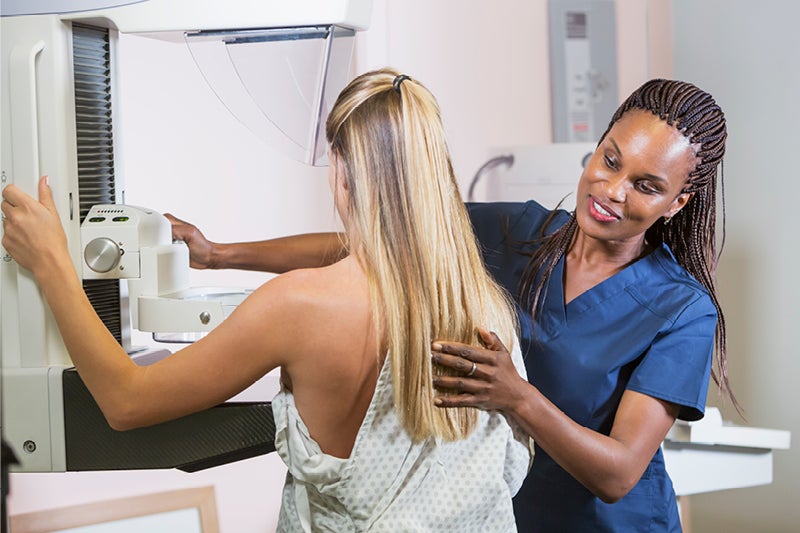
You’ll check in and then sit in a waiting area until your technologist calls your name. You’ll follow them to a changing room or the exam room, asked to remove your top clothing and given a hospital gown that you leave open and tie at the front.
Once you're ready, your technologist will show you how to stand in front of the mammogram machine and then position your breast correctly. While the mammographer is positioning your breast, you may feel embarrassed or awkward. This is normal; just remember it's a routine exam they perform on a daily basis.
Before the machine compresses your breast, you’ll be asked to hold your breath as the image is taken. At least two images are taken of each breast in different positions.
Does a mammogram hurt?
Yes and no. The x-ray itself doesn’t hurt, but the compression can be a bit uncomfortable. However, any discomfort doesn’t last long, and as soon as the image is taken, the compression is released.
After your first mammogram, you’ll know what to expect and subsequent appointments are more comfortable, emotionally and physically.
Do I need a mammogram if I have breast implants?
Yes. Technologists use special techniques to push the implant against the chest wall and pull breast tissue forward for imaging. This procedure is safe and important for cancer detection. It's extremely rare for a breast implant to rupture during the exam.
How long will the appointment take, and what will happen afterward?
You’ll probably be surprised how quickly your appointment is over. Most mammogram appointments are no longer than a half hour.
Once the technologist is finished taking the images, they'll leave the room to offer you privacy, or you will return to a changing room. Then, you'll get dressed and leave. Your images will be sent to a radiologist for review.
How will I get my results?
Your results will be shared with your primary care provider. If anything abnormal is found, you'll be notified and asked to come in for further testing. Again, don’t be scared if this happens; it doesn’t mean you definitely have breast cancer. This is exactly why mammograms are necessary to identify any issues earlier than later. Even if a lump is identified, it may not be cancerous.
Whether the results of your mammogram are normal or abnormal, you may receive a letter in the mail with the details of your exam, or you may receive information through your patient portal. For example, your exam may be normal but they identified that you have very dense breast tissue in one or both breasts. Dense breasts have more fibrous tissue than fatty tissue, making it more difficult to spot cancer on mammography. This doesn’t mean anything's abnormal, but it’s good to know.
What is a BI-RADS Score?
In your letter, you may see wording about BI-RADS (Breast Imaging-Reporting and Data System) classifications. Radiologists use this scoring system to categorize the results of mammograms, which are:
- BI-RADS 0: This means that the images were incomplete, and you may need further imaging.
- BI-RADS 1: No abnormal findings.
- BI-RADS 2: Non-cancerous findings. The images may show a cyst, but it isn’t cancer.
- BI-RADS 3: There is a very low chance that findings are cancerous, but a short-term follow-up is recommended.
- BI-RADS 4-5: Suspicious findings in the images, and a biopsy is usually recommended. Breast cancer is typically identified when the image shows a bright white spot or cluster, contrasting with dark gray fatty tissue.
Is there anything I should do between exams?
Self-breast exams should be done monthly. Getting to know your breasts helps you to easily identify if something feels abnormal. If something feels different or you notice a lump, contact your primary care provider immediately.
Getting a mammogram isn't something most women look forward to, but as you age, it becomes far more comfortable. Taking care of yourself is important and getting mammograms is a vital component of your wellness routine.
This blog was medically reviewed by a MercyOne provider.