
“Everything went right” during life-threatening stroke
July 17, 2026Categories: Stroke Care, Neurosciences
Learn more about MercyOne Stroke Care
Call it a “stroke of luck” or a miracle that Drew Strube happened to be with medical providers at the beginning of his rare and life-threatening stroke.
It began with a loud buzzing in his head at 5:30 a.m. May 6 while getting dressed after an overnight sleep study. He sat down; he felt dizzy and unsteady trying to stand up again. He lay on the bed as the room spun. He could barely respond to the voice at the door that asked, “Are you OK?” His mind was lucid but trapped in a body losing control. Sleep center staff called 911.
“When I realized I was having trouble speaking, stroke was the first thing that came to my mind,” said Drew, 42, of Waukee, Iowa. “I knew the symptoms of stroke, but at the same time, I thought, ‘No way am I having a stroke.’”
When minutes matter
From there, “Everything that could go right went right,” said Drew, a lifetime fitness enthusiast and weightlifter. EMTs knew to transport Drew to MercyOne Des Moines Medical Center, a top stroke center, as paralysis progressed on his right side and he couldn’t talk. Drew’s CT scan showed a clot in the basilar artery, most likely from a tear in the inner wall of this vital blood vessel to his brain. A clot-busting infusion was given; a thrombectomy performed; and the life-threatening clot cleared.
Within only three hours, Drew woke up physically and neurologically normal by 8:30 a.m. He and his wife credit God and the MercyOne Des Moines Stroke Center, central Iowa’s only Advanced Trombectomy –Capable Stroke Center, for his survival.
“Drew was incredibly fortunate to be in the hands of medical professionals at the onset of his stroke and taken to the hospital with a top stroke center,” said Drew’s wife, Jaclyn. “What a miracle it is for Drew to not only be alive after a stroke with an incredibly low chance of survival but to wake up in the shape he did."
Central Iowa's most advanced stroke care
When minutes mattered, interventional radiologist Alan McDaniel, MD, inserted a catheter through the femoral artery in the groin and threaded it up to the blocked artery in his brain to restore blood flow.
A basilar artery blockage can cause quadriplegia, coma or even death. However, thrombectomy interventions like that offered at MercyOne Des Moines Medical Center can greatly improve survival and recovery.
Drew recalled: “Even going into surgery, I was convinced this wasn’t a stroke. I seriously thought, ‘I’ll be at the high school by this afternoon’” where he coaches football at Waukee High School.
At the hospital, Jaclyn had a more frightening awareness as the blockage stole her husband’s smile and speech. She remembers: “Drew’s face lit up when he saw me, but his smile...” With one side of his body paralyzed, his smile looked like the corners of his mouth “were being pulled like a rubberband” in opposite directions. She turned away to regain her composure and tell herself “He needs you. You’re going to have to get it together.”
For Jaclyn, the hardest part was thinking “How can he come back from this? His face and whole body were so affected.”
Compassionate and rapid care
When emergency physician Heather Poskevich, DO, asked if she had questions, Jaclyn asked “Is there any chance of recovery or have we already passed that?” Dr. Poskevich told her there was a chance, but Drew’s situation was very serious.
The minute the scan detected a clot in the basilar artery, “As fast as they could lock the gurney in place, the team moved so quickly to get that TNK (clot-busting drug) into Drew and to get him ready for the thrombectomy.” The TNK brought improvement to Drew within about 90 seconds – he could speak again, and his face returned to near-normal, which gave Jaclyn hope for the next step.
Amid the whirlwind, an immobile Drew thought to himself, “Let’s see...can I move my right side? Nothing. No movement.”
Before the thrombectomy, Dr. McDaniel told Jaclyn, “We’re going to do everything we can.” He said that without the procedure, the outcome was not good. He also shared that he was skilled at the procedure and affirmed that MercyOne was the right place to be. That confidence comforted Jaclyn, who knew the sooner the procedure, the better chance her husband had.
Less than 30 minutes later, Jaclyn looked for a sign of hope as Dr. McDaniel approached after the thrombectomy. “I was worried that he was about to tell me Drew didn’t make it.” Instead, Dr. McDaniel told Jaclyn that he got the clot, and while he didn’t like to give false hope when someone has a stroke like this, he was very optimistic. Drew had passed every test already. Everyone was immediately hopeful for a full recovery.
Drew recalled, “I was still in Interventional Radiology when someone told me, ‘You’re lucky you’re here.’ There’s only two people that do this procedure in central Iowa, and they’re both at this hospital.’”
Upbeat and recovering
Drew continues physical therapy and exercise to get back to optimal physical fitness. Thus far, no risk factors for stroke have been identified, so it’s likely the arterial tear occurred when he was doing “very heavy weightlifting.” Drew doesn’t want this rare occurrence that led to his stroke to deter others from physical fitness, his passion since age 11.
“I’m not ignorant to the irony that the way I worked out on Monday likely caused the dissection that led to my stroke on Wednesday.” Drew said. “It’s probably from 20-plus years of wear and one wrong move the day it likely tore. However, the last thing I want anyone to take away from my story is that they shouldn’t lift weights or exercise hard.”
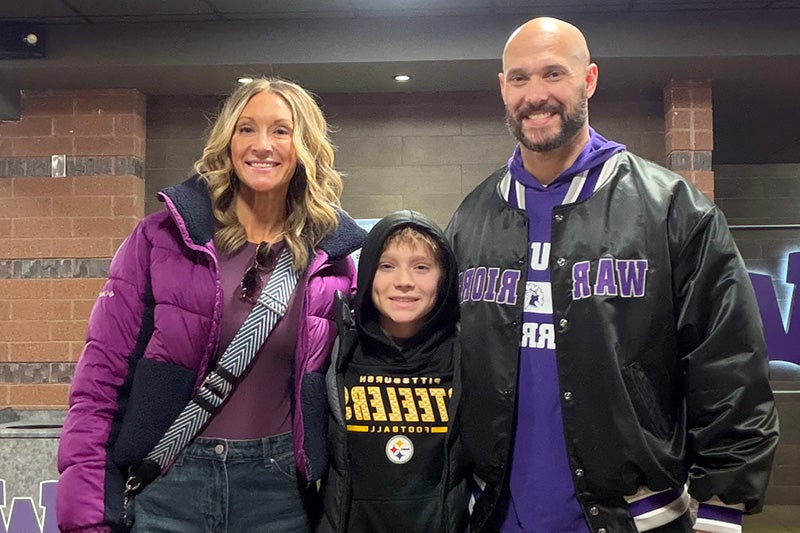
This health challenge has made him appreciate just how blessed he is. “Statistically, I know I shouldn’t be in the great shape I’m in,” Drew said. Drew has returned to his full-time job in the non-profit space and is back to coaching the Waukee Warriors in football and strength and conditioning. Most importantly, he’s glad to be here for Jaclyn and their son, Major.
It was due to a cancellation that Drew had his sleep study a month earlier than scheduled. “On the day of my stroke, I could have been driving to the high school for early morning weights instead of being at the sleep center. If so many people hadn’t done their jobs to the best of their abilities, I wouldn’t be here today.”