
24 years with MS and the MercyOne neurologist who “saved” her
August 4, 2026Categories: Neurosciences
Learn more about MercyOne Neuroscience Care
The unusual symptoms began to add up. One day, Jennifer Gogerty saw colors differently. Another day, she’d wake up to numbness over half her body. Then, she’d have trouble holding a baby spoon to feed her infant son or hook her necklace. If she had coins in her pocket, her fingers couldn’t distinguish between the dime, penny, nickel or quarter.
“It was frightening. I couldn’t will my body to do what I wanted it to do.”
Her multiple sclerosis (MS) diagnosis came on July 31, 2002, when a doctor entered the exam room with a foreboding welcome: “I’ve been dreading your appointment all day.” The minute the doctor left the room, Jennifer burst into tears in the arms of her husband, Eric, her rock.
“I didn’t know what MS was, I didn’t know if it was going to kill me or if I would see my 11-month-old son, Neil, grow up,” Jennifer said. “I was 27 years old, a brand-new mom and life as I knew it had imploded. I didn’t know what the future would look like.”
Turns out, the future looked like this
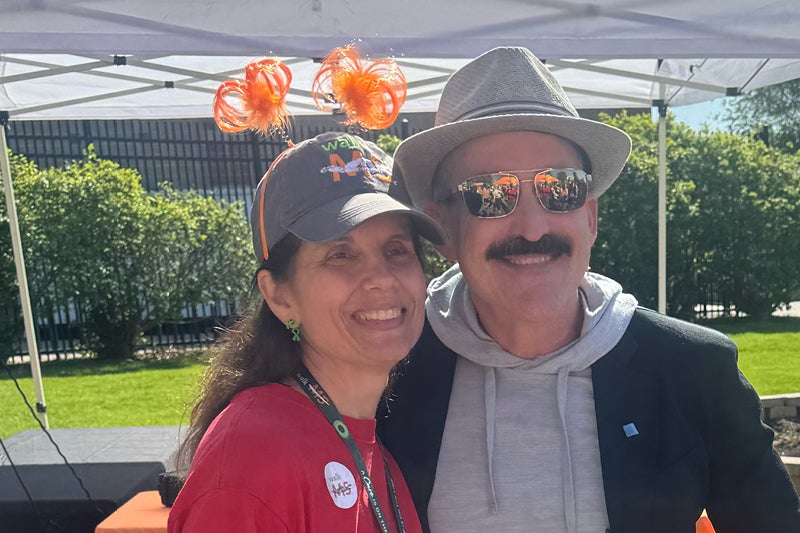
Nearly 25 years later, on one of the best days of her life, Jennifer stood on stage in May 2026 as the official Honoree of the regional MS Walk in Des Moines, Iowa.
Joining her on stage was Bruce Hughes, MD, the MercyOne Ruan Neurology Care neurologist who changed her life and has been part of her entire journey with MS. Desperate for answers, Jennifer sought his expertise and became his patient three months after her diagnosis.
“Dr. Hughes has seen me through really, really, really bad times. I was scared about my MS journey, and he brought me stability, comfort and hope. I’ve told him on multiple occasions, ‘You saved my life, or at least the quality of my life, and I’m forever grateful.’”
Becoming Dr. Hughes’ patient has been well worth the four-hour, round-trip drive from her Mason City, Iowa, home to Des Moines for each appointment, she said. “He’s an amazing human -- always positive, always encouraging, always prepared for my appointment, and always up on the latest MS treatments.”
Unpredictable symptoms
MS is a chronic, autoimmune disease of the central nervous system, which includes the brain, spinal cord and optic nerves. MS disrupts the flow of information within the brain and between the brain and the rest of the body. As Jennifer can attest, the disease can change from day to day and year to year.
Overwhelming fatigue, memory difficulties, mobility and balance issues, mood changes, numbness, pain, tingling, vision impairment: Symptoms depend on the inflammation and damage occurring at any specific time.
With her diagnosis, Jennifer would quickly discover a frustrating hallmark of MS -- its unpredictability. It would take years to get her MS under control.
“They call MS ‘the snowflake disease’ because no one’s the same. You might have similar commonalities, but no one’s experience is the same,” Jennifer said.
She feels fortunate to have relapsing- remitting MS, which means she has flare-ups or “exacerbations” of neurologic symptoms followed by partial or complete recovery, or remission.
From denial to new normals
Jennifer lived in denial the first years after her diagnosis, accompanied by even more years of revolving symptoms that brought new challenges and uncertainty. Today, her MS symptoms have stabilized, with the help of an immunosuppressive therapy called Tysabri. She does get to stay in Mason City when she receives her one-hour infusion every 28 days.
“If you looked at me today, you wouldn’t say ‘That woman has had MS for nearly 25 years.’ But there are challenges you don’t see behind the scenes,” Jennifer said. “When MS reared its ugly head and I couldn’t use parts of my body, I’d think, ‘Is this what life is going to be like from now on?’ You never know how well you’re going to recover.”
She has temporarily lost her ability to write. Poor balance has caused multiple broken toes, but unlike some patients with primary-progressive MS, she doesn’t need to use assistive devices or a wheelchair to walk. Fatigue is an ongoing symptom.
“The fatigue can be so intense for me that if I was sitting on my couch and there was a big bag of $1 million across the room, I’d be so fatigued I couldn’t stand up to go get it.”
She must always adjust to a “new normal,” depending on her symptoms, and wonder when or if she’ll recover the skill she’s lost.
Today, she’s an MS Ambassador and chronicles her experiences online. During her monthly Tysabri infusions, she spends the time focusing on “gratitude” and the amazing people she’s met on her MS journey, including Dr. Hughes, and the many family, friends and co-workers who’ve helped her along the way. And what about the son she worried she would never see grow up? Neil is now in dental school.
Dr. Hughes commends Jennifer for the strides she has made in managing her MS: "Jennifer Gogerty is a model patient and an excellent partner in collaborative, shared decision-making healthcare. She is blessed to have an excellent support system of a loving family.”
Looking out at the supportive crowd as the 2026 MS Walk Honoree, with Dr. Hughes as her special guest, Jennifer recalls “being on Cloud 9.”
“I wouldn’t be where I am in life if I’d not made the decision to go to MercyOne in Des Moines and have Dr. Hughes as my neurologist. He’s the best and has such passion for his patients.”