
The gift of early detection: Lung screening finds early cancer in 50-year smoker
September 4, 2026Categories: Cancer Care
Lung cancer screening at MercyOne Signs and symptoms of lung cancer
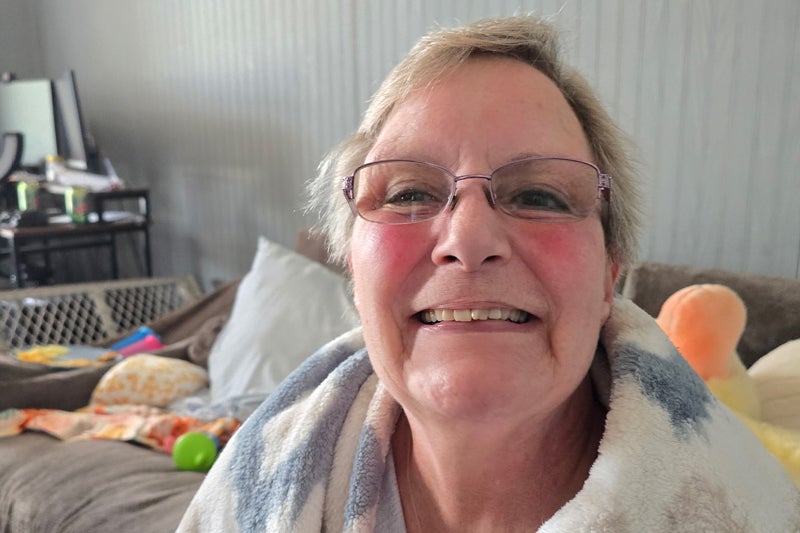
It was a blessed day when Shelly Speakman received a letter offering her a free CT lung cancer screening. A smoker since age 12, she knew 50 years of smoking put her at high risk for lung cancer. She thought “Sure, why not?”
That screening was a "gift" that would keep on giving.
Her first screening detected “spots” on her lung, and as a result, Shelly began a yearly lung CT screening regimen at MercyOne Des Moines Medical Center. Her 2023 screening showed a small lung nodule, or abnormal growth. By her 2024 screening, the lung nodule had doubled in size. A lung biopsy, using the latest robotic technology, found Shelly had non-small cell lung cancer.
The gift of lung screening
Thanks to yearly lung screenings, Shelly’s lung cancer was detected at an early stage – and before she even had symptoms – greatly increasing her odds of surviving the No. 1 cancer killer in Iowa and the U.S. Smoking is still the No. 1 risk factor for lung cancer.
“If I hadn’t had the lung CT scan, I’d never have known about the spots on my lung that would need to be watched. Two years later, I was diagnosed with lung cancer, but I never had shortness of breath or pain...no symptoms at all,” said Shelly, 65, of Madrid, Iowa.
“Without the yearly screenings, I probably would not have been diagnosed with lung cancer until I had symptoms, and the disease was much worse and more difficult to treat.”
The lung screening uses a low-dose computed tomography (LDCT) scan. Medicare and most private insurers cover lung cancer screening once per year for those who meet certain criteria. (ages 50-77, with a significant smoking history).
Early lung cancer often has no warning signs and may not appear until the disease has advanced. A lung screening looks for lung cancer before symptoms appear. “It’s quick, painless and well worth it, “ Shelly said. She encourages smokers to ask their doctor if they qualify for lung screening.
The power of robotics
Shelly had the power of MercyOne’s leadership in robotic technology for her lung biopsy and surgery. For her, that meant smaller incisions, a shorter hospital stay and a quicker recovery.
First, Shelly’s lung nodule was biopsied using robotic bronchoscopy. MercyOne Des Moines Medical Center was the first in Iowa to offer minimally invasive lung biopsies for small, hard- to-reach lung nodules to test for cancer. The robotic bronchoscopy uses an ultra-thin catheter, paired with a 3D map of the lungs generated from CT imaging, to navigate and reach nodules across all 18 lung segments for biopsy.
Just before Christmas 2024, Shelly received her diagnosis -- non-small cell lung cancer. It was a gift, she says, to learn it was an early stage.
In early 2025, she visited the multidisciplinary MercyOne Lung Cancer Clinic, where she met with multiple specialists -- all focused on her and her cancer treatment. Fortunately, she was a candidate for surgery -- the gold standard for early-stage lung cancer. She received a robotic wedge resection to remove a small part of the diseased lung on Jan. 14, 2025.
“I was excited to have robotic surgery. It’s cutting edge and uses small incisions instead of a large incision. I was happy about a shorter recovery and less scarring. The chest tube was a little uncomfortable, but the surgery was fine,” Shelly said. “They got all the cancer, and I didn’t have to have radiation or chemotherapy.”
Since her surgery, she sees MercyOne oncologist Brian Freeman, MD, and is happy to have had two more clear CT lung scans. She will have a scan once a year for five years.
Saved by a letter
Shelly sometimes thinks back to that letter she received, inviting Medicare/Medicaid recipients to have the free lung CT screening. She feels lucky it led her on a path to regular lung CT scans at MercyOne.
She knows how devastating advanced cancer can be.
A year ago, she lost her son to brain cancer; he served in Iraq and was exposed to dangerous chemicals from the burn pits that likely caused his cancer. Shelly’s father had genetic blood syndrome and passed away from leukemia.
Now in retirement, she will always remember her favorite job as a preschool teacher. However, she also had factory jobs that exposed her to environmental toxins from asbestos to paper dust – another risk factor for lung cancer.
With a new lease on life, her great grandchildren are her pride and joy, and she loves to read with her dog, Scotchie, snuggled on her lap. She has drastically reduced her smoking and is down to half a cigarette each morning. “I can’t seem to get rid of that one.”
She encourages smokers to see if they qualify for a lung cancer screening. “Get the screening done. It’s really, really important.”